Blog · Guide
A brand is a shortcut. Agents don't take shortcuts.
Brands exist because humans have limited patience for evaluating options. Agents have effectively unlimited patience — which changes what you have to publish in order to get recommended.
By Sascha Hoffmann · Published · Markdown
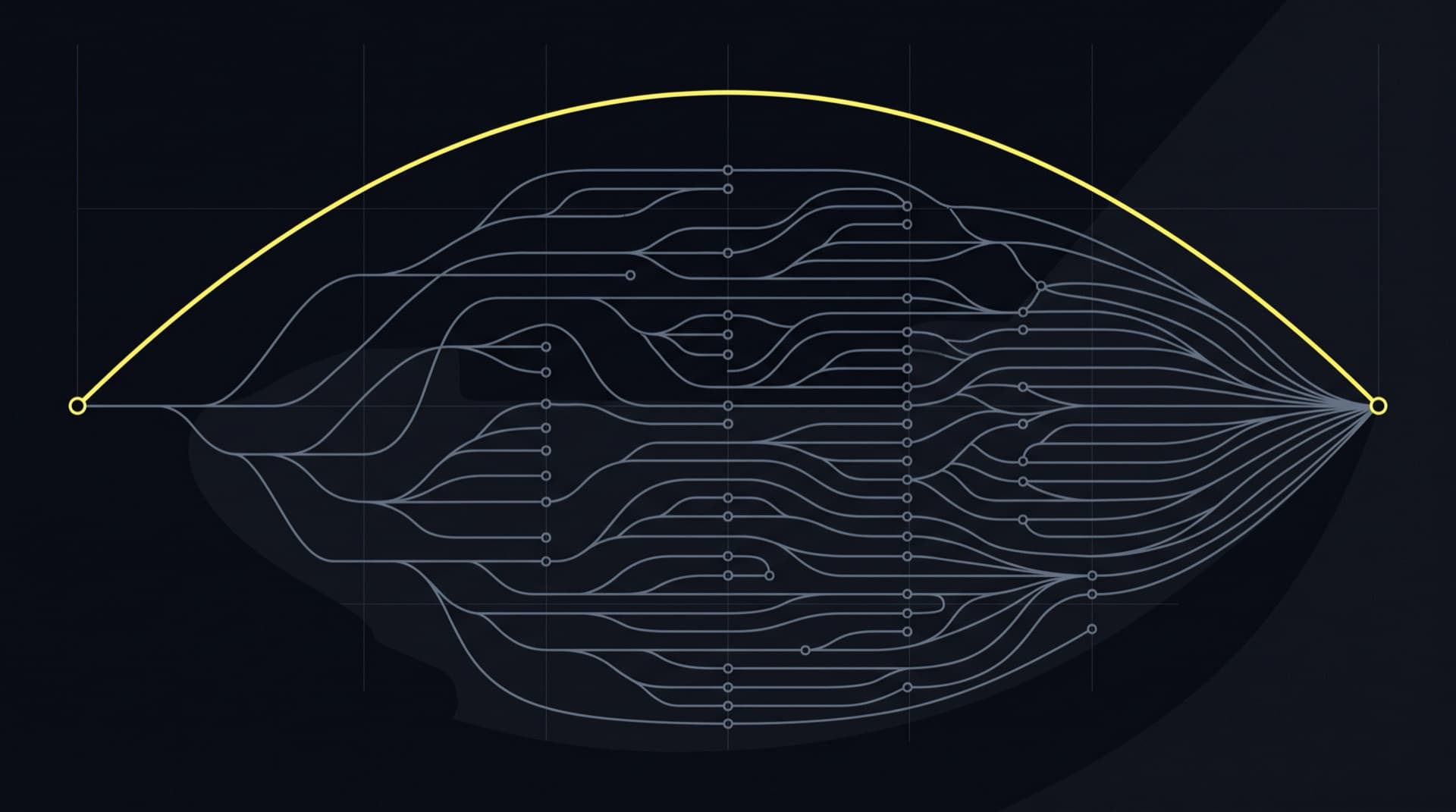
Matthew Prince, CEO of Cloudflare, made an observation on the Mad Podcast that has had far less attention than his traffic numbers, and is arguably the more uncomfortable one.
A brand, he points out, has always been a shortcut for humans. See a Marriott sign on a building and you know roughly what the room will look like before you walk in. See the McDonald's arches in a city you have never visited and you can predict the menu, the price range and the state of the toilets. You are not evaluating. You are recognising, and skipping the evaluation.
Then the line that should make any marketing team sit up: bots have infinite patience to discover everything that might be true.
The shortcut solves a constraint. The constraint is gone.
What a brand actually does
Strip away the workshops and a brand is a compression algorithm for evaluation cost.
Nobody has time to read every spec sheet, call every reference, or compare eleven vendors properly. So we learn to substitute a cheap signal — a name we recognise, a logo we have seen before, a reputation someone mentioned once — for the expensive work of actually checking. That substitution is rational. Under a time budget it is the only sane move.
Everything downstream follows from it. You buy awareness because being remembered beats being better. You buy the top of the shortlist because most people never reach the bottom. You keep the message simple because a complicated truth loses to a memorable simplification.
Every one of those tactics is an answer to the buyer will not do the work.
The buyer's agent will do the work
An agent researching a purchase does not get tired at vendor four. It does not decide the comparison table is too long. It will read your pricing page, your documentation, your changelog, three review sites, a two-year-old forum thread where a customer complained about your onboarding, and your competitor's page about you.
Prince's numbers give the order of magnitude: a person shopping for a camera might visit five sites, an agent might visit five thousand.
Five thousand sites is not a shortcut. It is the exhaustive evaluation your brand was built to let people skip.
So the mechanism that made recognition valuable — I will not check, so I will trust the familiar name — stops applying at exactly the moment the buyer delegates. The agent has no reason to lean on the familiar name, because checking is nearly free.
What this does not mean
It would be easy, and wrong, to conclude that brand is dead. Two things clearly survive, and one of them gets stronger.
Being the entity, not the adjective. If models have absorbed enough about you that your name is a thing they know rather than a string they have to go and look up, you start every answer already inside it. That is brand, and it is worth more, not less. It is also not available to most companies by next quarter.
Reputation as evidence. An agent weighing options absolutely uses third-party signal — reviews, citations, who else uses you. That is reputation doing work. The difference is that it now has to be findable and specific, not merely felt. "Widely trusted" is not evidence. Four hundred reviews with a visible distribution is.
Prince himself is careful here, and it is worth copying his caution: he says he has ideas about what a brand becomes in this world, but that it is going to get discovered over the next five years. Anybody selling you a finished framework for agentic branding today is ahead of the evidence.
What follows is not a theory of the future. It is what already works differently.
What replaces the shortcut: claims a machine can check
If the buyer will verify everything, the winning move is to be the easiest thing to verify.
Publish the number, not the impression. "Enterprise-grade pricing" survives contact with a human who cannot be bothered to ask. It does not survive an agent comparing four vendors on total cost, which will simply omit the one that would not say. A price in the HTML as a number, and in structured data as a number, is not a marketing decision any more. It is eligibility.
Be specific enough to be wrong. "Fast" is unfalsifiable, which sounds safe and is actually fatal — an unfalsifiable claim carries no information, so a system trying to give a defensible answer cannot use it. "P95 under 200 ms in the EU region" can be checked, which is exactly why it can be quoted.
Publish your limits. This is the counterintuitive one. Say plainly who you are not for and what you do not do. Two things happen. An agent looking for a disqualifier finds yours, stated by you, in your framing — rather than finding a competitor's comparison page and taking theirs. And an agent matching a buyer who is a fit gets a cleaner signal that they are. Vagueness protected you when the reader would not dig. It exposes you when they will.
Make every surface agree. Your site, your docs, your pricing page, your listings on three directories, your legal notice. A human reads one of those. A system reads all of them in one pass and notices that your pricing page says €49 while a two-year-old directory listing says €29. To a human that is a stale page. To a model reconciling sources it is a reliability problem, and the safe move is to reach for a vendor whose facts do not contradict each other.
That last point is the whole game, and it is why contradictions are more expensive now than they have ever been. Being out of date in one obscure place used to cost you nothing, because nobody cross-referenced. Now everything is cross-referenced by default.
How to test where you actually stand
You cannot fix this by reasoning about it. You have to look at the output.
- Write down the five questions a buyer asks before choosing in your category. Not "what is your product" — real buying questions. "Which X is best for a 20-person team?" "What does X cost?" "X versus Y for Z?"
- Ask them in ChatGPT, Claude, Perplexity and Gemini, with web search on. Same wording, all four.
- Record three things per answer: were you named at all, was what it said about you accurate, and which competitor was named ahead of you.
- Check every claim it made about you against your own pages. Where the model was wrong, find the page it was probably reading. That page is your bug report.
- Repeat monthly. A single run tells you where you are. It cannot tell you whether anything you changed helped.
Step four is where most of the value sits, and it is the step people skip. When a model quotes a price you stopped charging eighteen months ago, that is not a hallucination to complain about. It is a source you forgot to update, and it is findable.
The short version
Brands were an answer to scarce attention. On the buyer's side of the transaction, attention is no longer the binding constraint — verification cost was, and it has collapsed.
What compounds now is not how memorable your claim is. It is how easy it is for a machine to confirm.